
What Is an ESA (And Why This Changes Everything for Tutors)
An Education Savings Account (ESA) is state-funded money given directly to families to pay for their child’s education.
Instead of going only to schools, families can use it for:
- Tutoring
- Curriculum
- Online programs
- Therapy and specialized support
Here’s the key shift:
“The ESA model facilitates the ‘unbundling’ of education, enabling families to construct a bespoke learning experience that incorporates private tutoring…”
👉 Families are no longer limited by school systems or budgets—they are building customized education plans.
And tutors are a key part of that.
“Homeschool Families Can’t Afford Me” (Let’s Fix That)
This belief used to be true.
It’s not anymore.
Many ESA programs provide:
- $2,000–$10,000+ per year per child
From the research:
“The primary barrier… the significant out-of-pocket cost… is increasingly mitigated by state-level ESA disbursements.”
👉 Translation:
Families who couldn’t afford tutoring before…
now can.
Where ESA Exists (And Why Tutors Should Care)
ESA programs are expanding quickly across the U.S.
States like:
- Arizona
- Florida
- Utah
- West Virginia
- Iowa
have already expanded access significantly
👉 And more states are following.

Families in these states are actively looking for tutors right now.
The Real Problem (And Your Opportunity)
Right now, there’s a disconnect.
ESA Families Don’t Know:
- Where to find tutors
- Who accepts ESA funds
- Who they can trust
Tutors Don’t Know:
- How to get in front of ESA families
- How ESA payments work
- That families can actually afford them
👉 That gap is your opportunity.
How ESA Families Actually Search for Tutors
ESA families don’t search like traditional clients.
They look in places like:
- Google (“ESA tutor near me”)
- Facebook homeschool groups
- ESA platforms (ClassWallet, Odyssey)
- Word of mouth
- Google Business listings
👉 Key insight:
It’s not just about having a website—
it’s about showing up where parents are already looking.
8 Ways to Get Found by ESA Families
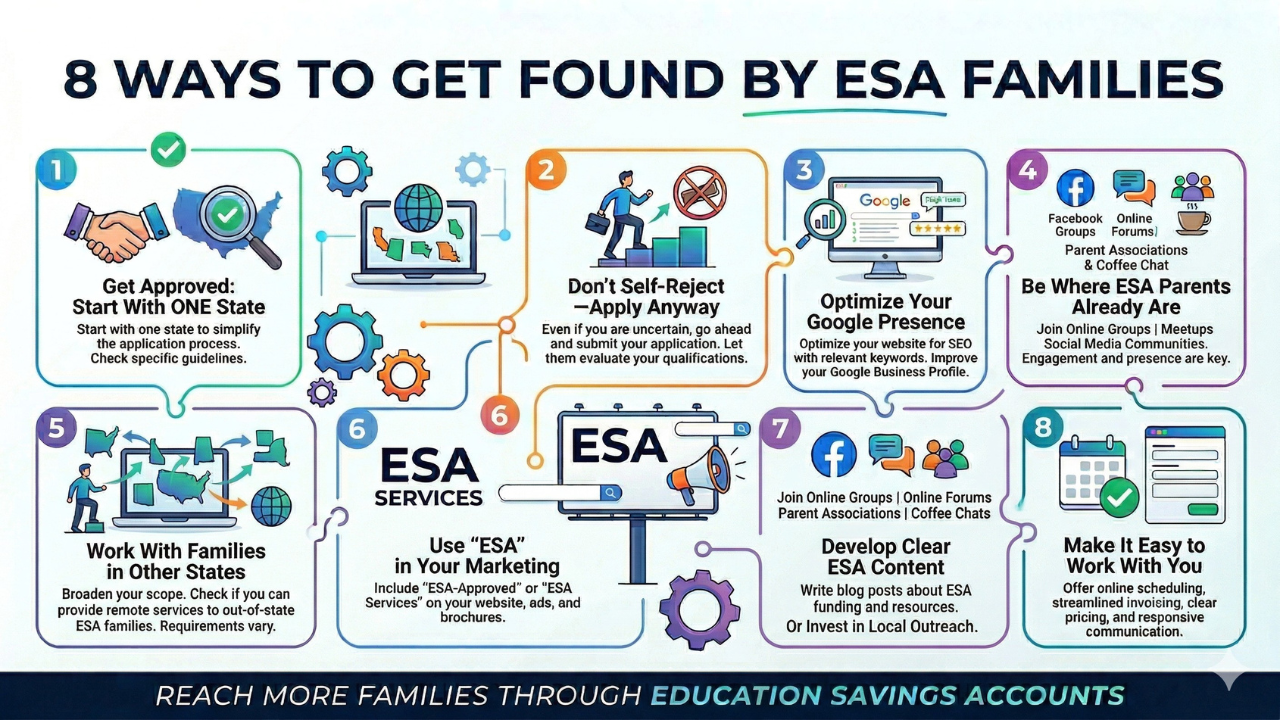
1. Get Approved (Start With ONE State)
Don’t try to apply everywhere.
Start with one state:
- Learn the system
- Get approved
- Build confidence
Once you do:
👉 You can say “I accept ESA funds”
2. You Can Work With Families in Other States
Even if you don’t live there.
Because:
👉 Many ESA families use online tutors
Instead of applying everywhere upfront:
- Get approved in one state
- Apply in others as families reach out
Position yourself like this:
“I accept ESA funds and can apply in your state if needed.”
This builds immediate trust.
3. Don’t Self-Reject—Apply Anyway
Some states say:
- “Must be a licensed teacher”
But that doesn’t always stop approvals.
👉 Even if you’re unsure:
Apply anyway.
Let the state decide.
4. Use the Word “ESA” in Your Marketing
Parents are searching for:
- “ESA tutor”
- “Accepts ESA funds”
So your messaging should include:
- “ESA Approved Tutor”
- “Accepting ESA Funds”
5. Optimize Your Google Presence
Your Google Business Profile matters.
Include:
- “Accepts ESA funds”
- Clear service descriptions
- Local keywords
6. Be Where ESA Parents Already Are
Join:
- Homeschool groups
- ESA Facebook communities
Don’t spam—be helpful.
👉 Trust builds visibility.
7. Make It Easy to Work With You
Parents are overwhelmed.
Make things simple:
- Explain ESA payments clearly once you understand them
- Guide them through the process
- Be flexible with approval
The Mistakes Tutors Are Making
- Not mentioning ESA
- Waiting to be approved everywhere
- Assuming families can’t afford tutoring
- Making payment complicated
👉 The biggest mistake?
Not positioning yourself for ESA families at all.
What ESA Families Actually Want
From working with parents:
They want:
- Someone who understands their child
- Clear, measurable progress
- Confidence—not confusion
- Simple communication
Parents aren’t just looking for a tutor…
they’re looking for someone they trust with their child’s progress.
Want Help Getting Families to Find You for Tutoring?
If you want help:
- Getting found online
- Attracting the right families
- Building a consistent tutoring business
👉 The Insider Secrets Club shows you exactly how to do this without relying on tutoring companies that underpay you and overcharge families.
About the Author
Joanne Kaminski is a reading specialist and tutor mentor who helps educators connect with families who are actively searching for support—but don’t always know where to find it.
With experience working with over 300 students, Joanne understands what families truly want: clear progress, confidence, and someone they can trust with their child’s learning. Her work with struggling readers gives her a unique perspective on how parents search for help—and what makes them choose one tutor over another.
Joanne is the creator of the Insider Secrets Club, where she teaches tutors how to get found online, attract the right families, and build sustainable tutoring businesses, without relying on companies that take a large portion of their earnings.
She also has firsthand experience navigating ESA systems, including becoming an approved provider and helping families understand how to use their funding for tutoring.
Because for Joanne, it’s not just about marketing, it’s about making sure the right tutor finds the right student at the right time.
References
The Policy Circle. (n.d.). Education savings accounts and their growing impact. https://www.thepolicycircle.org/minibrief/education-savings-accounts/
Texas Policy Research. (n.d.). School vouchers vs. education savings accounts: Key differences explained. https://www.texaspolicyresearch.com/school-vouchers-vs-education-savings-accounts-key-differences-explained/
EdChoice. (n.d.). What is an education savings account (ESA)? https://www.edchoice.org/school-choice/education-savings-account/
American Federation for Children. (n.d.). Programs & eligibility. https://www.federationforchildren.org/school-choice-in-america/programs-and-eligibility/
Ballotpedia. (n.d.). School choice in the United States. https://ballotpedia.org/School_choice_in_the_United_States
Ballotpedia. (n.d.). States with and without universal school choice programs. https://ballotpedia.org/States_with_and_without_universal_school_choice_programs
National Conference of State Legislatures. (n.d.). Education choice state policy scan: Education savings accounts. https://www.ncsl.org/education/education-choice-state-policy-scan-education-savings-accounts
Common Sense Institute. (2025). ESA’s in Arizona Q3 2025 report. https://www.commonsenseinstituteus.org/arizona/research/education/esas-in-arizona-q3-2025-report
Savvy Learning. (n.d.). Tutoring for homeschoolers: Online vs in-person guide. https://savvylearning.com/blog/tutoring-for-homeschoolers-online-vs-in-person/
Outschool. (n.d.). How one Arizona family found freedom, joy, and hidden talents through homeschooling with ESA and Outschool. https://outschool.com/articles/how-one-arizona-family-found-freedom-joy-and-hidden-talents-through-homeschooling-with-esa-and-outschool
Want to learn how to get students for your tutoring business?
Download 50 + Ways to Get Online Tutoring Students.
